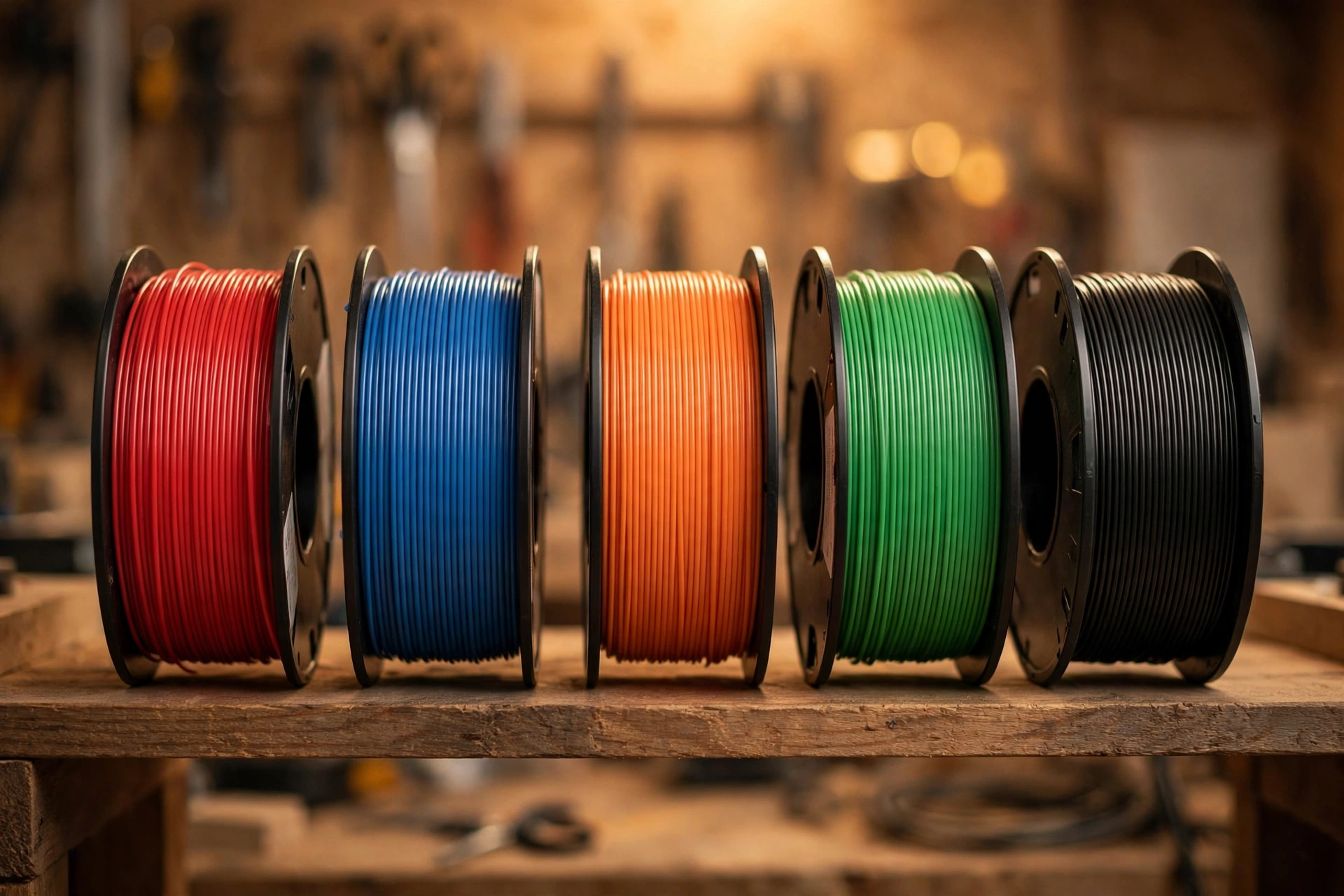
Almost every 3D printer on the market runs PLA — polylactic acid — as its default material, and for good reason. It prints at modest temperatures, barely warps, needs no enclosure, and comes in more colors and finishes than any other filament. But "PLA" on a listing is not a quality grade. Diameter tolerance, winding quality, and color consistency vary wildly between spools, and a bad spool causes the exact failures beginners blame on their printer: clogs, inconsistent extrusion, and stringing that no slicer setting fixes. This guide explains the specs that actually matter, picks the best PLA for everyday printing, silk, matte, and specialty finishes, and covers the storage and nozzle rules that keep every spool printing well.
Last updated: October 7, 2026 · Prices and availability checked October 2026.
PrintDialed is reader-supported. When you buy through links on our site, we may earn an affiliate commission.
Our picks
- SUNLU PLA Plus Best everyday
- AMOLEN Silk PLA Best for display
- SUNLU Matte PLA Best professional look
- SUNLU Wood PLA Best texture
- Glow-in-the-dark PLA+ bundle Most fun
- Multi-color PLA bundle Best value expansion
| Product | Best for | Key spec | Price |
|---|---|---|---|
| SUNLU PLA Plus | 80% of printing | ±0.02–0.03 mm tolerance; vacuum-sealed | Check price → |
| AMOLEN Silk PLA | Vases, figurines, cosplay props | Glossy metallic finish | Check price → |
| SUNLU Matte PLA | Enclosures, organizers, gifts | Fingerprint-resistant matte finish | Check price → |
| SUNLU Wood PLA | Wood-like prints that take stain | Real wood fibers; needs 0.5–0.6 mm nozzle | Check price → |
| Glow-in-the-dark PLA+ bundle | Kids' prints and decorations | Strontium-aluminate pigment | Check price → |
How we test
We compare manufacturer specs, community feedback, and verified owner reviews; we don’t accept free products for placement.
Why PLA is still the best default
PLA is made from plant starch (usually corn), prints around 190–220°C, and works on every FDM printer without an enclosure or special ventilation. It is stiff, holds fine detail beautifully, bridges well, and is easy to sand, glue, and paint. For decorative prints, prototypes, organizers, toys, and most hobby parts, nothing beats it on ease of use.
The honest limits: PLA softens around 60°C, so it does not belong in a hot car, a sunny window, or near a heat source. It is more brittle than PETG, so snap-fit parts and anything under repeated flex will eventually crack. And it is not UV-stable long term — outdoor parts get chalky and weak over months of sun. If you need heat resistance or toughness, our functional filaments guide covers PETG, ASA, and beyond. For everything else, PLA is the right call.
The specs that separate good PLA from bad
Diameter tolerance: "1.75 mm filament" is a nominal value, not a promise. Good PLA holds ±0.02–0.03 mm; cheap PLA drifts ±0.05 mm or worse. The extruder pushes a fixed volume per step, so a thin section under-extrudes (weak, gappy walls) and a thick section over-extrudes or jams in the hotend. Listings that publish tolerance data — and independent reviews that verify it — beat mystery spools every time.
Winding quality: neat, layer-by-layer winding feeds smoothly; sloppy cross-wound spools tangle mid-print and ruin a 12-hour job at hour nine. You can judge this the moment you open the box: the filament should lie in clean parallel rows, not a bird's nest. Cardboard versus plastic spool matters less than the winding itself, though cardboard spools can shed dust into enclosed filament changers.
Color accuracy and batch consistency: if you are printing a multi-part project, two spools of "the same" color from a bargain brand can differ visibly. Established brands keep color consistent batch to batch, which matters for anything assembled from separately printed parts.
Packaging: vacuum-sealed with desiccant, ideally with a humidity indicator card. A spool that arrives unsealed has already been drinking humidity in a warehouse, and you will be drying it before the first print.
The picks: best PLA filaments
Every pick below is chosen for printability on common machines — Bambu Lab, Creality, Elegoo, Flashforge, Anycubic — at standard 190–220°C settings. Prices move; check current listings.
Best everyday: standard PLA, 1 kg spool Best everyday
 SUNLU PLA Plus 3D Printer Filament, 1.75mm, 10 ColorsCheck price on Amazon →
For roughly 80% of printing you want one reliable workhorse spool, not ten exotic ones. Look for published ±0.02–0.03 mm tolerance, vacuum sealing, and a brand with a long review history rather than a listing that appeared last month. Start with black, white, or gray — the colors that hide layer lines, photograph well, and take paint if you ever want it. Buy your second spool only after the first prints cleanly; a known-good spool is also your diagnostic tool when a new spool misbehaves.
Pros
- One reliable workhorse spool for most printing
- Doubles as your diagnostic tool when a new spool misbehaves
Cons
- Avoid listings with no review history
Our verdict: One reliable workhorse spool beats ten exotic ones.
Best for: Everyday printing in black, white, or gray. Not ideal for: Heat, sun, or loaded functional parts.
Best for display pieces: silk PLA Best for display
 AMOLEN Silk PLA 3D Printer Filament Bundle, Shiny DualCheck price on Amazon →
Silk PLA contains additives that give a glossy, almost metallic finish straight off the build plate — it hides layer lines beautifully and makes vases, figurines, and cosplay props look expensive. The trade-offs are real: silk is slightly more brittle than standard PLA, stringier, and fussier about retraction. Dry the spool before important prints and slow down 10–15%. The result is worth the tuning for anything that will be looked at rather than loaded.
Pros
- Hides layer lines; looks expensive off the plate
- Great for anything that will be looked at
Cons
- Slightly more brittle than standard PLA
- Stringier and fussier about retraction
Our verdict: For anything that will be looked at rather than loaded.
Best for: Display pieces and gifts. Not ideal for: Functional or load-bearing parts.
Best clean professional look: matte PLA Best professional look
 SUNLU 1KG PLA Matte 3D Printer Filament 1.75mm, Matte BlackCheck price on Amazon →
Matte PLA hides layer lines without the brittleness of silk, resists fingerprints, and photographs like a manufactured part rather than a hobby print. It is the best choice for enclosures, desk organizers, gifts, and anything that should look "designed" rather than "printed." Print settings are nearly identical to standard PLA, which makes it the easiest upgrade in this guide — same profile, better-looking parts.
Pros
- Hides layer lines without silk’s brittleness
- Same print settings as standard PLA
Cons
- Fewer flashy color options than standard PLA
Our verdict: The easiest upgrade in this guide — same profile, better-looking parts.
Best for: Anything that should look “designed” rather than “printed.” Not ideal for: High-heat or outdoor use.
Best texture: wood-fill PLA Best texture
 SUNLU PLA 3D Printer Filament, Wood Color, 1KGCheck price on Amazon →
Real wood fibers in a PLA base print with a matte, wood-like texture and a faint grain pattern that takes stain and sanding surprisingly well. Two rules: use a 0.5–0.6 mm nozzle (the fibers clog 0.4 mm nozzles) and treat it as mildly abrasive — a hardened steel nozzle is strongly recommended. Print a few degrees hotter than standard PLA and expect a slightly rougher surface, which is the entire point.
Pros
- Matte wood-like texture with faint grain
- Takes stain and sanding surprisingly well
Cons
- Clogs 0.4 mm nozzles — use 0.5–0.6 mm
- Mildly abrasive; hardened nozzle recommended
Our verdict: Gorgeous results — just respect the nozzle rules.
Best for: Decorative pieces with a wood look. Not ideal for: Fine detail work or 0.4 mm nozzles.
Best fun: glow-in-the-dark PLA Most fun
 Glow in the Dark PLA+ Filament, 6 Pack 200g Spool Bundle,Check price on Amazon →
Strontium-aluminate pigments charge in ambient light and glow for hours — great for kids' prints, Halloween decorations, and light-switch covers. This is the most abrasive filament in the guide: the glow powder will visibly wear a brass nozzle within a single spool, so a hardened steel nozzle is mandatory, not optional. Charge test: hold the print under a bright light for a minute, then check it in a dark room before committing to a big print.
Pros
- Charges in ambient light; glows for hours
- Great for kids’ prints and Halloween
Cons
- Most abrasive filament in the guide
- Hardened steel nozzle is mandatory, not optional
Our verdict: The most fun filament here — and the hardest on brass nozzles.
Best for: Fun prints: toys, decorations, light-switch covers. Not ideal for: Any brass-nozzle printer.
Best value expansion: multi-color PLA bundles Best value expansion
Once you have a workhorse color dialed in, a 4–8 spool bundle of assorted colors is the cheapest way to expand the palette — often 20–30% less per spool than buying singles. The caveat: bundles from established brands keep the same tolerance and winding as their singles; bargain bundles are exactly where diameter problems hide. Buy the bundle from the brand whose single spool already printed well for you.
Pros
- Cheapest way to expand your color palette
- Established brands keep bundle quality equal to singles
Cons
- Bargain bundles hide diameter problems
- Buy the brand whose single spool already printed well
Our verdict: Expand the palette with the brand whose single spool already printed well.
Best for: Makers with a dialed-in workhorse color. Not ideal for: Untested bargain-brand bundles.
Specialty PLA and the hardened nozzle rule
Any PLA with stuff in it — wood fibers, glow powder, marble dust, carbon fiber, glitter — is abrasive. A brass nozzle's 0.4 mm hole becomes an oval 0.5 mm within a spool or two, and print quality degrades so gradually you will blame the slicer before the hardware. Swap to a hardened steel nozzle before the first specialty spool (see our printer upgrades guide), print abrasives a few degrees hotter and a little slower, and keep one brass nozzle reserved for clean standard PLA.
One more specialty note: "marble" and "granite" PLA variants look fantastic for statues and lithophanes but share the abrasion issue. And avoid "color-changing" or "temperature-sensitive" PLA as anything but a novelty — the effect fades, the base plastic is ordinary, and the premium buys you a party trick, not better prints.
Keeping PLA dry: storage that actually works
PLA absorbs moisture slowly — weeks, not hours — but wet PLA pops and crackles at the nozzle, strings badly, and loses layer adhesion. The system that works: in humid climates, print from a filament dryer box that feeds the printer directly. Store opened spools in sealed bins or vacuum bags with rechargeable desiccant, and re-dry any spool that starts crackling at 55°C for 4–6 hours.
A cheap hygrometer in the storage bin tells you whether your system works — aim for under 20% relative humidity in the bin. Unopened, vacuum-sealed spools keep for years in a closet; an opened spool on a shelf in a humid garage is a different story. When a print that used to work starts stringing with the same settings and the same spool, moisture is the first suspect, not your slicer profile.
What not to buy
Skip no-name multi-packs with no published tolerance data — inconsistent diameter causes failures that look like printer problems and waste your time, not just your money. Treat "PLA+", "PLA Pro," and "tough PLA" as marketing, not a standard: some are genuinely tougher blends, most are ordinary PLA at a markup. Avoid clearance spools from unknown sellers (old, wet, tangled — the three horsemen of bad filament), and do not buy a 10-spool rainbow bundle as your first filament. Learn on one good spool, then expand.
Frequently asked questions
Can I mix PLA brands in one print?
Yes, for multicolor printing — purge 100–150 mm³ between colors so the transition is clean. Stick to the same material family (PLA to PLA); mixing PLA with PETG in one print causes adhesion problems at the boundary.
Does PLA expire?
Vacuum-sealed, it keeps for years. Opened, it depends on humidity: months in a dry climate, weeks in a humid garage before you notice degradation. When in doubt, dry the spool — a dryer box revives most "old" PLA completely.
Is PLA food safe?
The plastic itself is generally considered low-toxicity, but printed parts are not food safe: layer lines harbor bacteria that cannot be washed out, and standard brass nozzles contain lead. Do not make cups, cutlery, or anything that contacts food.
PLA or PETG for outdoor parts?
PETG. PLA softens in direct sun and heat — a black PLA bracket on a car dashboard will deform on the first hot day. PLA is for indoor parts; PETG, ASA, or nylon are for anything that lives outside or near heat.