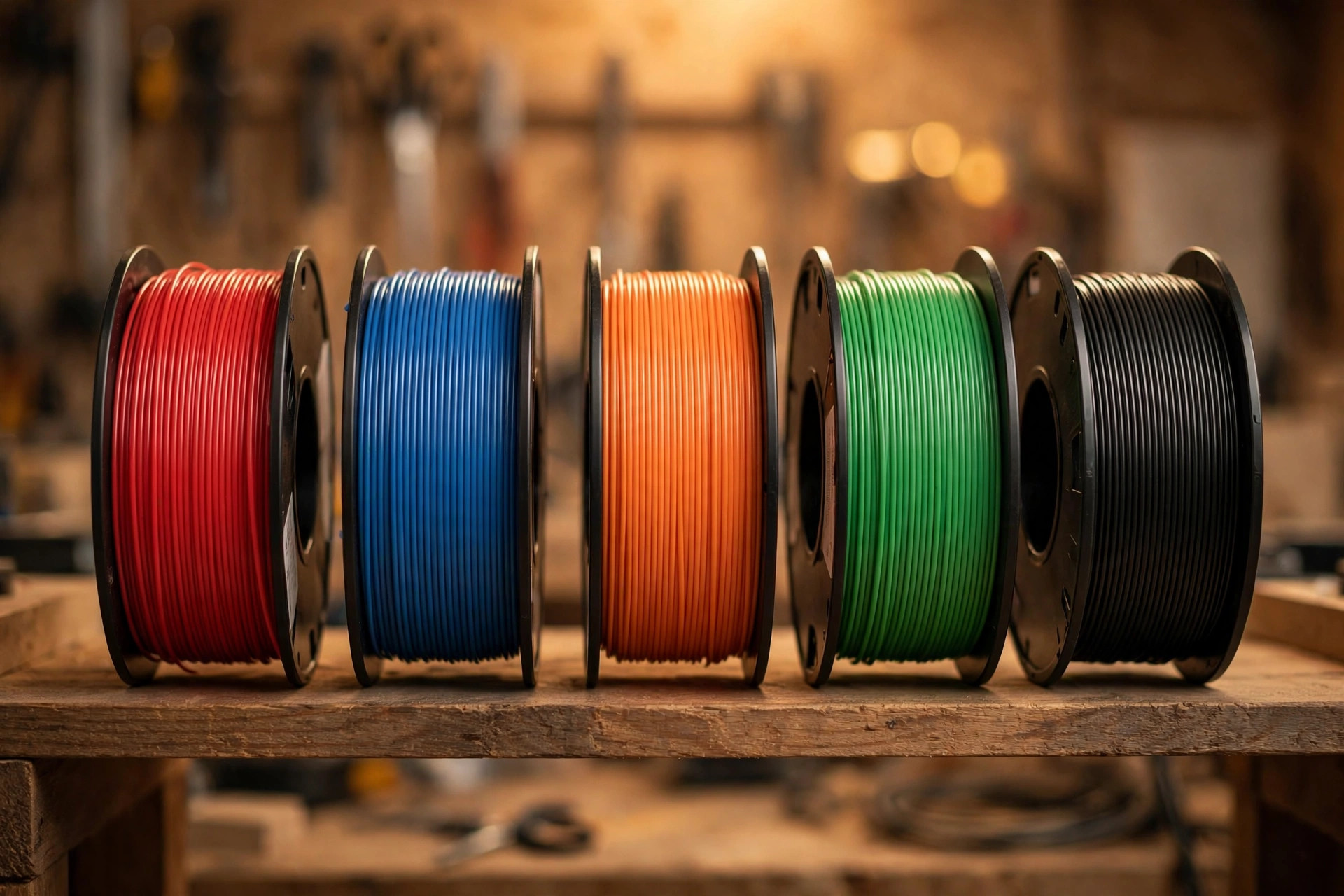
There is no single strongest filament. Tensile strength, impact resistance, stiffness, layer adhesion, fatigue life, heat resistance, and chemical tolerance describe different kinds of performance. A stiff bracket may crack when dropped; a flexible clip may survive thousands of cycles. The best functional material is the one that matches the part's real loads and the conditions where it will live.
Define the job before choosing a spool
Write down five things: the expected load, load direction, maximum temperature, exposure to sun or chemicals, and whether failure would be dangerous. A phone stand and a vehicle suspension component are both “functional,” but they should never share the same decision process. Consumer FDM parts are inappropriate for many life-safety, pressure, lifting, electrical-mains, food-contact, and high-temperature uses without qualified engineering and testing.
Also consider how the part attaches. Threads, snap fits, heat-set inserts, and screws concentrate stress. Printed orientation often matters as much as the polymer. Plan the layer lines so the major load does not simply pull layers apart.
PLA and PLA+: stiff and surprisingly capable
Standard PLA has useful stiffness, good dimensional accuracy, and excellent printability. It is a strong choice for indoor fixtures, drill guides, electronics mounts away from heat, tool organizers, prototypes, and jigs. PLA+ is a marketing category rather than one fixed chemistry; many blends improve impact behavior, but performance varies by manufacturer. Treat each product as its own material.
PLA's weakness is sustained heat and long-term load. A bracket can slowly deform under stress even below the temperature where it visibly softens. Avoid it in hot cars, near motors, or outdoors where sun and heat combine. Annealing can alter properties but also changes dimensions and may distort the part.
PETG: the useful generalist
PETG is often the most practical next step for functional parts. It has good layer bonding, better ductility than basic PLA, moderate chemical resistance, and improved temperature tolerance. It suits guards, workshop brackets, utility containers, clips, and outdoor parts where extreme heat is not expected. Its slight flexibility can be an advantage under impact.
Dry PETG carefully and avoid over-squishing the first layer. It can stick aggressively to some smooth beds, so follow surface guidance. For dimensional parts, tune flow and temperature before compensating every hole in CAD; excess extrusion can make features look undersized.
ABS and ASA: heat and weather options
ABS combines toughness, temperature resistance, and the ability to be solvent-smoothed or chemically welded. ASA offers similar printing demands with better ultraviolet and weather resistance, making it a common choice for exterior housings and fixtures. Both generally benefit from an enclosure and stable chamber conditions. Large parts can split internally even when the first layer remains attached.
Ventilation is part of the equipment, not an optional later upgrade. These materials emit particles and vapors during printing. Use a controlled, appropriate setup outside occupied living areas, and do not assume a small carbon pad eliminates every emission.
Nylon: impact and fatigue performance
Nylon can be excellent for gears, hinges, bushings, and parts that need toughness rather than stiffness. It is also highly moisture-sensitive. A spool can absorb enough water to print poorly within a short time in humid conditions. A capable dryer and a sealed path during printing may be necessary, not merely a storage bag.
Different nylons vary dramatically in temperature, stiffness, shrinkage, and bed requirements. Some need an enclosure and specialized surfaces. Start with a manufacturer profile and a small geometry before committing to a long functional part.
Polycarbonate and engineering blends
Polycarbonate can offer high strength and heat performance, but it demands sustained hotend temperature, a capable heated bed, controlled chamber conditions, and careful drying. Many consumer filaments labeled PC are blends formulated for easier printing; that can be useful, but the label alone does not establish properties. Read an actual technical data sheet and distinguish raw material data from printed-part test data.
Carbon- and glass-fiber-filled filaments
Chopped fibers usually increase stiffness, reduce visible warping, and create a matte surface. They do not automatically increase impact strength, layer bonding, or every tensile measurement. The fibers are abrasive and require a compatible hardened nozzle and filament path. Small nozzles may clog more readily, and the finished surface can expose fibers when sanded or damaged. Use dust control and appropriate protection during post-processing.
Design choices that create stronger prints
- Orient layers around the real load path.
- Add wall loops before excessive infill.
- Use generous fillets instead of sharp internal corners.
- Increase local thickness around fasteners.
- Choose infill that supports the expected direction of force.
- Print test coupons with the actual profile and orientation.
- Avoid notches, abrupt section changes, and screw over-tightening.
Temperature affects layer fusion, while excessive heat can reduce detail and create sagging. Cooling can strengthen small PLA features geometrically but weaken bonding when overused on materials that prefer a warm environment. A polished-looking part is not proof of structural performance.
A practical material ladder
Use PLA or a documented PLA+ for stiff indoor parts. Move to PETG for general toughness and moderate environmental exposure. Choose ASA for outdoor UV resistance, ABS for controlled heat-resistant work where its finishing properties help, and nylon for fatigue and impact when moisture management is available. Reserve polycarbonate and reinforced materials for printers and projects that truly require them.