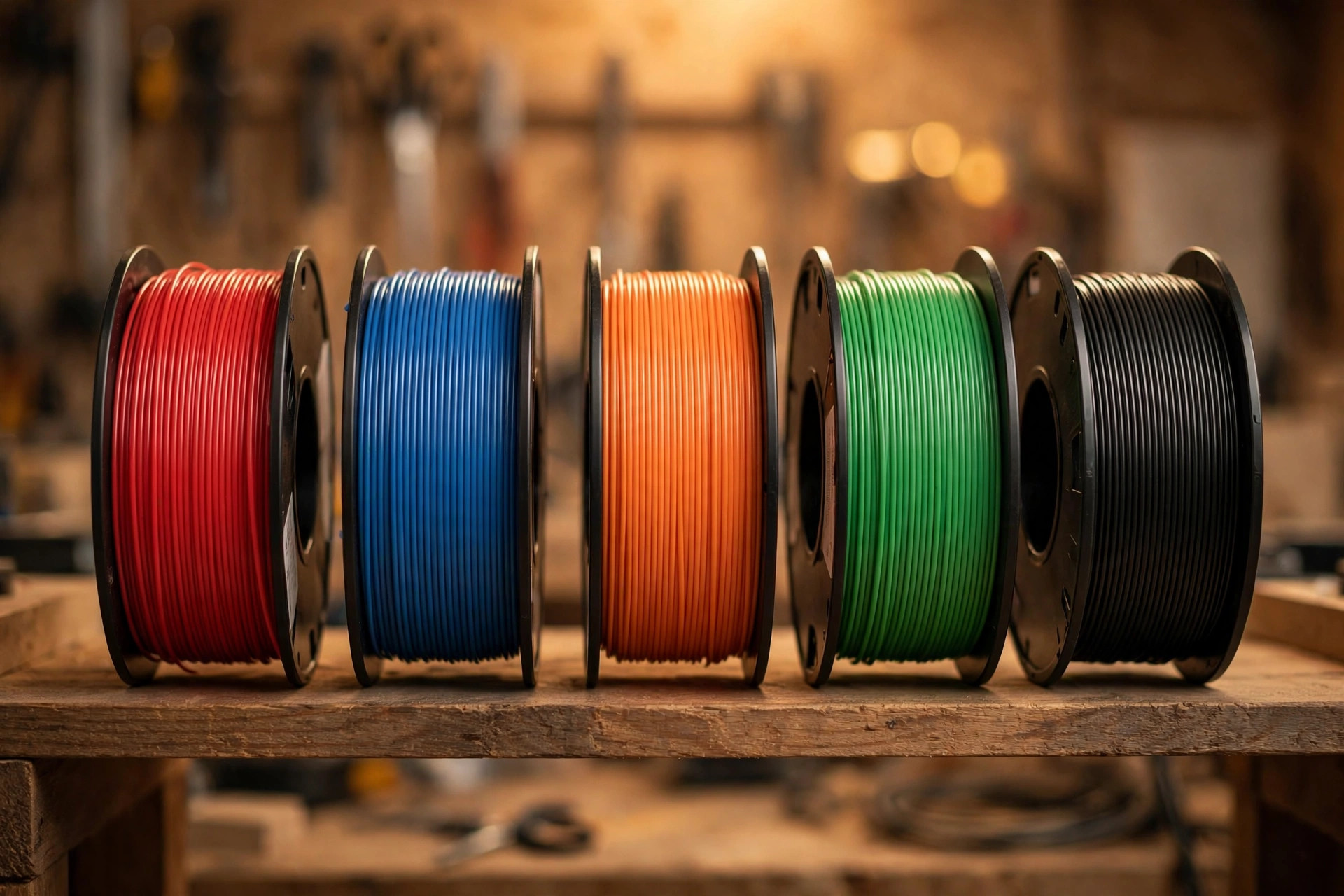
PLA, PETG, and ABS are the three filament names beginners encounter first, but “strongest” is the wrong way to compare them. A material can be stiff but brittle, flexible but durable, heat-resistant but difficult to print, or easy to print yet unsuitable for a hot car. The best starting filament is the one whose behavior matches both your printer and the finished part's environment.
The short answer: begin with PLA
For most first-time owners, PLA is the right baseline. It prints at relatively modest temperatures, shrinks less than ABS, adheres well to common build surfaces, and usually produces crisp detail with strong cooling. That does not make it a toy-only plastic. PLA can make excellent organizers, brackets used indoors, prototypes, models, jigs, and fixtures when the load and heat are reasonable.
Starting with PLA lets you learn bed cleaning, first-layer inspection, support placement, wall thickness, and slicer previewing without adding severe warping or enclosure management. Once you can recognize a healthy print, it is much easier to tell when a new material causes a change.
PLA: easy, stiff, and heat-limited
Where PLA excels
PLA is stiff, dimensionally stable, widely available, and offered in almost every color and surface effect. It is a good choice for display models, tool organizers, electronics housings that stay cool, drawer dividers, templates, decorative planters, and many light-duty household repairs. Matte and silk blends can change strength and print behavior, so ordinary PLA or PLA+ is best for establishing a baseline.
Where PLA struggles
Heat is the main limitation. A PLA part can soften or creep under load in a hot vehicle, near an appliance, or in direct summer sun. It may also fail suddenly at a sharp stress concentration. More infill does not fix poor material selection. For a clip that flexes repeatedly or a bracket mounted outdoors, PETG or another engineering material may be more appropriate.
PETG: tougher, more heat tolerant, and a little messier
PETG sits between PLA's ease and ABS's environmental resistance. It generally tolerates higher service temperatures than basic PLA, has good layer adhesion, and flexes more before breaking. It works well for functional containers, workshop fixtures, guards, outdoor parts with moderate exposure, and components that need impact resistance rather than maximum stiffness.
The learning curve comes from its sticky melt behavior. PETG can leave fine strings, collect blobs on the nozzle, and bond too aggressively to some smooth surfaces. It also absorbs moisture; popping sounds, rough extrusion, and excessive stringing often point to a wet spool rather than bad retraction settings. Use the plate preparation recommended by the manufacturer, because a release layer may protect certain beds.
ABS: useful performance with real setup demands
ABS is valued for toughness, post-processing options, and better heat resistance than PLA. It has a long history in functional and consumer parts. But it contracts significantly as it cools, so open printers and drafty rooms often produce lifted corners or layer splits. A stable heated enclosure is usually more important than endlessly increasing bed temperature.
Printing ABS also releases ultrafine particles and volatile compounds. An enclosure is not automatically ventilation; a sealed box may keep temperatures stable while allowing emissions to escape when opened. Use source capture or exhaust appropriate to the setup, keep the printer out of occupied sleeping or play areas, and follow material and printer guidance. Beginners should not choose ABS merely because a forum calls it “professional.”
Side-by-side practical comparison
- Easiest first layers: PLA.
- Best for repeated flex and general toughness: often PETG.
- Best of these three for higher heat: usually ABS, with the right printer and enclosure.
- Cleanest visual detail: usually standard PLA with strong cooling.
- Most prone to stringing: PETG, especially when wet.
- Most prone to warping: ABS.
- Lowest ventilation burden: PLA is generally the simplest, though all melting plastic deserves sensible ventilation.
Strength depends on print design
Material choice cannot rescue a badly oriented part. FDM prints are usually weaker between layers than along them. A hook printed upright may separate at its layer lines even when the same model printed on its side survives. Rounded inside corners, thicker walls, generous fillets, and load paths aligned with the layers often improve performance more than jumping to a harder filament.
For many practical parts, wall count matters more than very high infill. Three or four perimeters can provide an efficient shell, while 100% infill adds time, weight, and internal stress without guaranteeing the expected strength. Test the actual geometry under a safe version of the real load.
Storage and moisture
All three materials benefit from dry storage. Keep opened spools in sealed containers or bags with reusable desiccant and a humidity indicator. PETG often reveals moisture sooner through stringing and a rough surface. Dry only at a temperature suitable for that exact filament and spool; excessive heat can deform the spool before the material is restored.
A simple progression for beginners
Print one full spool of ordinary PLA before changing variables. Then try PETG on a practical project that benefits from impact or temperature resistance. Approach ABS only when you have a suitable enclosed machine, ventilation plan, and a part that truly needs it. Record nozzle temperature, bed temperature, cooling, and the result for each spool. That small habit builds a useful material library faster than downloading someone else's universal profile.