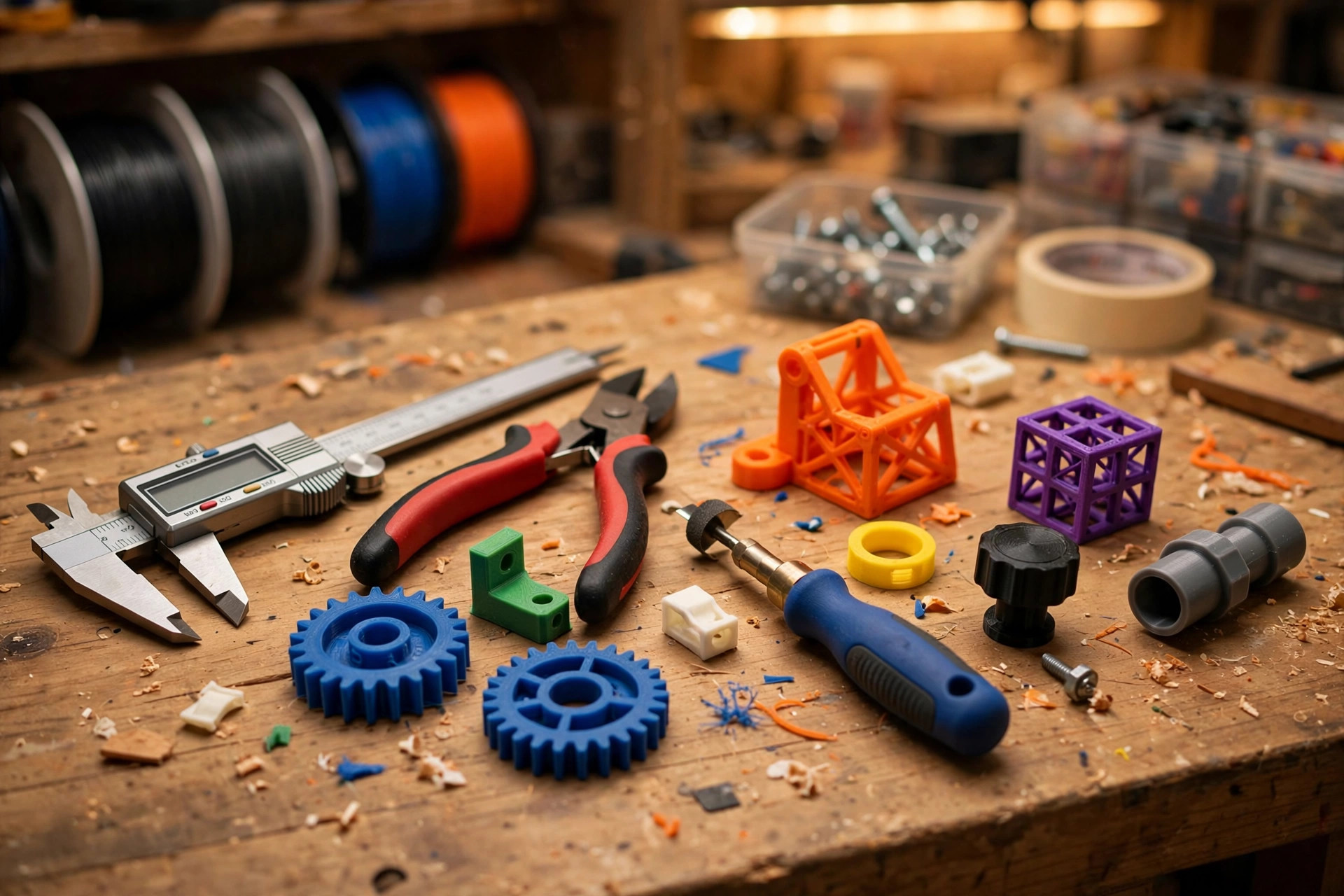
A 3D printer can arrive with a bag of tools, but that does not mean the bag contains the right tools—or that every accessory promoted online is useful. A small, deliberate kit is safer and more effective than a drawer full of gadgets. Start with tools that help you remove parts, inspect dimensions, control filament moisture, and perform the maintenance your machine's manual actually recommends.
The first-day toolkit
Flush cutters
A sharp pair of flush cutters trims filament cleanly before loading and removes support nubs after printing. Cut away from your body and wear eye protection; clipped plastic can launch farther than expected. Use the tool on filament and small plastic features, not steel wire or hardened pins, which can notch the blades. Keep it closed or capped when stored.
Plastic scraper or thin removal tool
Most parts should release from a flexible build plate after the plate cools and bends. A plastic scraper helps with brims and purge lines without gouging the surface. Metal blades can slip, cut hands, and damage coatings. If a print requires force, stop and let the plate cool completely; the correct solution is rarely more leverage.
Needle-nose pliers and tweezers
Pliers grip support material, hold hot purge strands at a safe distance, and retrieve dropped hardware. Fine tweezers can lift wisps from a cooled nozzle. Never reach near a moving toolhead, and do not touch the heater block immediately after the screen reports a lower temperature; metal retains heat.
Digital calipers
Calipers turn vague fit problems into measurable information. Use them to check filament diameter, hole size, wall thickness, hardware, and a finished test cube. Inexpensive digital calipers are adequate for everyday fitting, although they are not laboratory instruments. Zero the jaws before measuring and avoid overtightening them on soft parts.
Cleaning supplies that protect the printer
Keep plain dish soap and a dedicated lint-free towel for washing removable build plates. High-concentration isopropyl alcohol in a labeled dispenser is convenient between washes when the plate manufacturer allows it. Avoid scented cleaners, moisturized wipes, and paper products that leave additives or lint. A soft brass brush may clean an approved hot nozzle, but only after power-sensitive areas are protected and the machine guidance permits it.
A small vacuum with a nonconductive nozzle can collect plastic crumbs around the frame when the machine is powered off and cool. Compressed air often pushes debris into fans and electronics, so it is rarely the best choice. Never vacuum hot filament or use a household vacuum around loose conductive material.
Filament storage before fancy upgrades
Dry filament improves consistency more reliably than many printer modifications. Use sealable bins or heavy reusable bags with desiccant and a simple humidity card or hygrometer. Desiccant preserves dry material; it does not rapidly rescue a waterlogged spool. For that, use a purpose-built filament dryer or a carefully controlled device with a verified low-temperature range.
Store spools away from direct sun and dust. Label each with material, date opened, and any temperature range that worked. If a spool begins to pop, steam, string, or produce a rough finish, dry it before changing retraction and flow. Troubleshooting wet filament with slicer settings creates confusing profiles.
Spare parts worth owning
Keep two correct replacement nozzles, one compatible hotend sock, a small set of the exact machine screws that are easy to lose, and a spare build surface if the printer is used for deadlines. Nozzle formats that look similar may differ in length, thread, heat break, or calibration requirements. Buy by the exact printer and hotend revision, not appearance.
A complete spare hotend can be worthwhile for a quick-change system, especially if you switch between standard and abrasion-resistant nozzles. Hardened nozzles are useful for carbon-filled, glow, and other abrasive materials, but they can require temperature changes and may reduce thermal performance. Do not install one merely because it sounds durable.
Safety equipment
- Safety glasses for trimming supports or handling brittle parts.
- Heat-resistant gloves for rare maintenance that the manual requires near warm components—not for reaching into an active machine.
- A smoke alarm appropriate to the room and a clear path to a suitable extinguisher.
- Nitrile gloves for resin printing; ordinary FDM cleanup generally should not need them.
- Ventilation or source capture suited to the materials you print.
Tools to add when you design parts
A deburring tool makes quick work of hole edges and elephant-foot ridges, but its hooked blade is sharp and should be pulled away from hands. A stepped drill or hand reamer can bring printed holes to final size with more control than forcing a bolt through them. A metric hardware assortment—nuts, bolts, washers, and heat-set inserts—turns prototypes into durable assemblies.
For heat-set inserts, use a temperature-controlled soldering iron with a dedicated flat tip and a stable stand. Work in ventilation and practice on scraps. The goal is to sink the insert slowly and squarely, not melt a cavity around it. Keep the electronics soldering tip separate from the insert tip.
What not to buy yet
Skip giant nozzle packs, mystery lubricants, adhesive sprays, automatic fire-extinguisher gadgets, and upgrade kits recommended without a diagnosed problem. The wrong grease can attack plastic or collect grit. Adhesive can hide an unclean plate or incorrect first layer. Cheap nozzles introduce inconsistent orifices. A printer that works should earn upgrades one solved problem at a time.
A compact, practical setup
Begin with flush cutters, pliers, calipers, a plastic scraper, cleaning supplies, sealed filament storage, eye protection, and two verified spare nozzles. Add a dryer if your climate or materials justify it. Add finishing and assembly tools when projects demand them. Keep everything in a shallow organizer near—but not on—the printer. A controlled kit makes maintenance calmer, helps measurements stay repeatable, and keeps sharp tools out of casual reach.